Keyword Research · 9 min read
Daraz Keyword Competition: How to Find Better Search Opportunities
Understand Daraz keyword competition and learn how to balance search demand with ranking difficulty.
Updated 2026-09-13
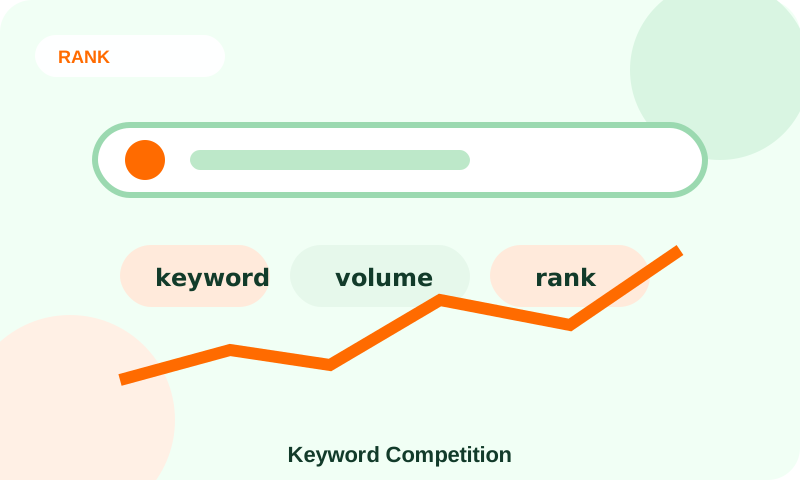
Keyword competition is the difficulty of gaining meaningful visibility for a search term. The biggest keyword is not always the best target because established listings may already have strong relevance and customer signals.
Separate demand from difficulty
A popular term can be valuable but difficult. A narrower term may attract fewer searches while producing more qualified shoppers.
Evaluate both potential demand and the strength of current results.
Inspect the current results
Search the keyword and examine the products appearing prominently. Compare their reviews, pricing, relevance and listing quality.
If results are weak or poorly aligned with the search intent, the opportunity may be stronger.
Find specific buyer language
Customers often search using features, use cases and problems. These terms can reveal more precise intent than broad category names.
Use them where they accurately describe the product.
Build a keyword priority list
Rank keywords by relevance, opportunity and competition. Your primary term should clearly describe the product, while secondary terms can cover features and use cases.
Keep the final list practical enough for listing optimization.
Avoid keyword stuffing
Search optimization should improve discovery without reducing readability. Repeating phrases unnaturally can make customers distrust a listing.
Write for the buyer first and use research to make the language precise.
Define the Business Question
Start by writing down the exact decision this research needs to support. The purpose is not to collect numbers simply because they are available. For balancing keyword demand, relevance and competitive difficulty, the useful question is whether the market gives a seller a realistic path to attract customers while controlling risk. Separate facts you can observe from estimates you are making. This makes the final decision easier to review and update. A research sheet should therefore contain the product or keyword, the market segment, the main competitors, the price range, the customer problem, the estimated economics and the reason the opportunity deserves another look.
Compare More Than One Result
Use several comparable examples before drawing a conclusion. One unusually cheap listing, one unusually expensive seller or one product with an exceptional review count can distort the picture. For balancing keyword demand, relevance and competitive difficulty, compare a group of relevant results and look for the normal range. Pay attention to patterns rather than isolated numbers. When several independent listings show similar behavior, the signal becomes more useful. When the results disagree sharply, investigate why before turning them into a business assumption. This habit helps prevent decisions based on a single attractive screenshot or a single competitor.
Understand the Customer
Customer intent should remain at the center of the analysis. A marketplace result is valuable only when it solves the problem the shopper actually has. For balancing keyword demand, relevance and competitive difficulty, ask what the customer is trying to accomplish, what information they need before buying and what could make them hesitate. Reviews, questions, specifications and listing language can reveal these details. Use that information to improve the product proposition, not merely to imitate competitors. A seller who understands the buying decision can often compete through clarity and relevance even when another store has more history.
Read the Competitive Landscape
Competition should be viewed as a collection of strengths and weaknesses rather than a simple count. For balancing keyword demand, relevance and competitive difficulty, identify established sellers, newer sellers, premium offers and budget offers. Then examine what each group does well. A dominant seller may have strong trust but weak content; a cheap seller may have attractive pricing but limited differentiation; a premium seller may serve a smaller audience. Mapping these positions helps you choose where to compete. It also prevents the common mistake of entering a market without understanding which customer segment you are actually targeting.
Connect Price With Economics
Pricing needs to be connected to value and cost. For balancing keyword demand, relevance and competitive difficulty, record the realistic customer price and then work backward through product cost, marketplace expenses, fulfillment, packaging, returns and promotion. Do not use the highest visible price as your default assumption. A sustainable price should leave room for normal competitive movement while preserving a sensible contribution margin. If a small competitor discount would eliminate your profit, the product is highly price-sensitive. If customers can see meaningful value in your offer, you may have more flexibility than a pure price competitor.
Treat Estimates Correctly
Research estimates should be treated as decision-support signals, not promises. For balancing keyword demand, relevance and competitive difficulty, estimated sales, revenue, demand or competition can help prioritize candidates, but actual results depend on listing quality, inventory, conversion, pricing, customer experience and changing marketplace conditions. Record the assumptions behind every estimate. If the assumption changes, the decision should be easy to recalculate. This is particularly important when comparing products with very different price points. A consistent methodology is more valuable than pretending that an uncertain number has more precision than the available evidence supports.
Consider Operational Reality
Operational difficulty can change an attractive market into a difficult business. For balancing keyword demand, relevance and competitive difficulty, consider sourcing consistency, product quality, packaging, delivery requirements, storage, returns and customer support. A product with a good theoretical margin may require so much handling that the practical economics become weak. Conversely, a simpler product may be easier to scale even with a slightly lower margin. Include these factors in the shortlist instead of evaluating only demand and price. Good marketplace research considers the complete path from supplier to customer, not just the search result page.
Build Meaningful Differentiation
Differentiation does not always mean inventing a completely new product. For balancing keyword demand, relevance and competitive difficulty, differentiation can come from a better bundle, clearer specifications, improved packaging, a more useful variation, better images, stronger customer guidance or a product quality improvement. The important test is whether the difference matters to the customer and can be delivered consistently. Avoid adding features that increase cost without increasing perceived value. A simple, well-executed offer can be more competitive than a complicated offer that customers do not understand.
Create a Validation Plan
Build a validation step into the research process. For balancing keyword demand, relevance and competitive difficulty, choose a small number of assumptions that can be tested quickly: expected price, customer response, product quality, supplier reliability or listing conversion. Define what success would look like before starting the test. This prevents changing the goal after seeing the result. Research is most powerful when it creates a cycle of hypothesis, test, measurement and improvement. Each cycle should reduce uncertainty and make the next inventory or marketing decision more informed.
Document What You Learn
Document why a candidate was selected and why alternatives were rejected. For balancing keyword demand, relevance and competitive difficulty, keep the original observations, assumptions and expected outcome together. Later, compare actual performance with the original reasoning. This creates a learning loop that improves future product research. It also helps a team communicate decisions without relying on memory. Over time, the research library becomes an asset: successful patterns can be repeated, failed assumptions can be avoided and category knowledge can become deeper. The goal is not to make one perfect decision but to improve decision quality consistently.
Turn Research Into Action
Nyeeds can be used as part of this workflow by bringing marketplace research signals into a more organized process. For balancing keyword demand, relevance and competitive difficulty, use product, seller, keyword, pricing and market information as inputs, then apply your own commercial judgment to the final decision. The platform should help reduce the time spent collecting and comparing information; it should not encourage blind reliance on a score. Treat every opportunity as a hypothesis that needs validation. This approach keeps the research practical and makes the transition from analysis to action much clearer.
Complete a Final Risk Check
Before acting, perform a final risk check. For balancing keyword demand, relevance and competitive difficulty, ask what could make the opportunity fail: a sudden price war, weak supplier quality, seasonal demand, high returns, inaccurate estimates, limited stock or a stronger competitor. Then decide whether the risk can be reduced through a smaller test, better sourcing, improved positioning or a different product. A strong opportunity is not one with zero risk. It is one where the important risks are visible, measurable and manageable. That distinction can save significant capital and make marketplace growth more sustainable.
Frequently Asked Questions
Is Daraz product research enough to guarantee sales?
No. Product research reduces uncertainty but cannot guarantee sales. Demand, competition, pricing, seller execution, stock availability, reviews, seasonality and marketing can all change the result.
Are Nyeeds sales and revenue figures exact?
Research figures should be treated as estimates unless they come directly from an authorized seller account. Market research data can change and should be combined with your own validation.
Can beginners use Nyeeds for Daraz research?
Yes. Start with one product category, compare several competing listings, study pricing and reviews, and then validate the opportunity before investing.
Final Takeaway
Keyword opportunity comes from the combination of relevance, customer intent and competitive difficulty. A smaller but highly relevant term can be more useful than a huge generic keyword.